
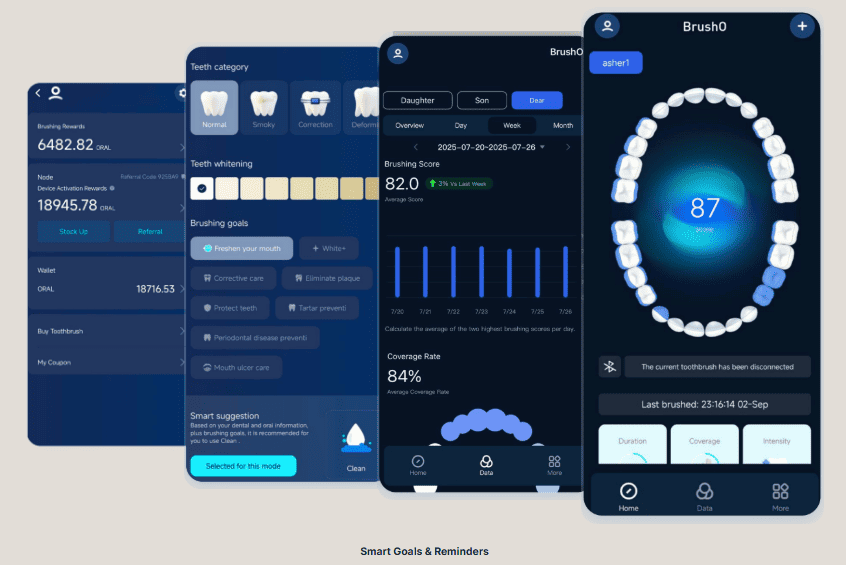
Imagine a toothbrush that gives you a personal report card every day. Instead of wondering whether you brushed long enough or missed a spot, the BrushO AI-Powered Toothbrush delivers daily, weekly, and monthly reports straight to your app. With smart sensors, AI-driven tracking, and a privacy-first design, BrushO transforms brushing into a guided health routine, helping families and individuals maintain healthier teeth and gums.
Most people assume that brushing twice a day is enough. But studies show:
70% of users don’t brush for the full two minutes.
One-third of tooth surfaces are often missed.
Over-brushing can damage enamel and gums.
A brushing report solves this problem by giving clear feedback: how long you brushed, which areas you missed, and how your oral health habits change over time.
The BrushO Toothbrush uses sensors and AI to analyze every brushing session:
Daily Reports → Track your performance each day with coverage and pressure insights.
Weekly Reports → See patterns, like whether weekends are your weak spots.
Monthly Reports → Get a big-picture view of your oral health consistency.
Instead of vague reminders, you get real data to improve your brushing routine.
BrushO is more than a smart toothbrush—it’s an oral health companion:
Real-Time Feedback → Alerts if you brush too hard or miss an area.
App Integration → Reports are stored securely, fully under user control.
Replaceable Brush Head Design → Ensures hygienic, effective cleaning without extra waste.
Privacy-First → Brushing data is decentralized, meaning it belongs to you—not stored on vulnerable central servers.
Parents can check if kids really brushed for two minutes.
Teens with braces can see if brackets and wires are cleaned properly.
Adults can stay motivated with streaks and progress scores.
Seniors can ensure they brush gently enough to protect their gums.
Everyone in the household gets a clear, personalized report that turns brushing into a habit you can trust.
An AI toothbrush with personalized reports changes the way we think about oral care. Instead of brushing blindly, BrushO users get daily, weekly, and monthly insights that help prevent cavities, protect gums, and build lifelong healthy habits.

Whitening toothpaste can feel harsher on receding gumlines because exposed root surfaces and thinned tissue react differently to abrasive polishing, flavoring, and repeated brushing pressure. The problem is often the combination of product choice and technique rather than whitening alone.

Half awake brushing often fails because attention is not fully online yet. Voice prompts can rescue those sessions by replacing fuzzy self direction with simple real time cues that keep zone order, coverage, and timing from drifting while the brain is still catching up.

Sinus congestion can make upper teeth feel sore, full, or oddly pressurized because the tissues above the roots and around the face become inflamed and crowded. The sensation is often more about shared anatomy and pressure transfer than about a tooth problem starting on its own.

Salty snacks can make tiny mouth sores feel much bigger by pulling moisture from tender tissue, increasing friction, and keeping irritated spots active after the snack is gone. Texture, dryness, and repeated grazing often matter as much as the salt itself.

Molar root furcations create branching anatomy that makes plaque control more demanding when gum support changes or furcation entrances become exposed. Cleaning difficulty comes from shape, access, and brushing blind spots more than from neglect alone.

Retainers can make back molars harder to clean by creating extra edges, pressure points, and blind spots where plaque lingers. The problem is often not the appliance itself but the small behavior changes it creates around chewing, salivary flow, and brushing coverage.

Primary teeth have thinner enamel than adult teeth, which helps explain why small changes in plaque, snacking, and brushing can lead to faster visible damage in children. The difference is structural, not just behavioral, and it changes how parents should think about daily care.

Fizzy water can seem harmless, yet its acidity and sipping pattern may keep already sensitive teeth from settling down. The issue is usually not one dramatic drink but repeated low-level exposure on teeth with open dentin, wear, or recent enamel softening.

Dentin helps teeth handle everyday biting by flexing slightly and distributing stress before enamel has to carry it alone. This layered design explains why teeth can feel strong and still become vulnerable when dentin is exposed or dehydrated.

Bedtime brushing often fails at the family level because everyone is tired on a different schedule. Sync prompts can help by creating a shared transition into brushing before fatigue, distractions, and one more task syndrome push the routine too late.

Build an oral health data network quickly and at low cost in a way that everyone can build.


Address: RM 1427, 14/F RADIO CITY 505, HENNESSY RD CAUSEWAY BAY, HONG KONG
Code: 000000
Phone: +852-53758652
Email: customerservice@brusho.com